So What About Risk?
Leave a commentDecember 1, 2012 by Susie Ting
When did we become so cautious? Or develop this mindset that if something is risky, we should avoid it? Why can we accept failure on the chin but cower from risk because…well …’it’s risky’? These are some of the questions that have been pestering me for some time.
I suppose some blame must rest on how inadequate but all-encompassing the word “risk” is. Just like in failure, the word “risk” implies a raft of potential consequences that might occur. We may risk something trivial, like not taking an umbrella or something more serious such as parachuting, bungy jumping, or betting the family firm on a hunch. Considering that all actions involve some risk, it is not surprising that sometimes we lump together all our perceptions of risk and imagine extreme outcomes.
Without risk we cannot achieve learning or growth—it is essential. Yet somewhere along the line, we learned that we should cocoon ourselves from all risk and stick to the safe path Further, we protect ourselves from risk through processes, rules and laws, (sometimes with stifling or crippling effects on our forward thinking and creative processes). In an increasingly competitive world, this is worrying.
So, how do we change this? Learn to differentiate between necessary risk protection and our risk averse mentality, a mentality that’s suffocating our creative will and mind?
My belief is that we need to view risk in the same way as we view our emotions. For risk and emotions share many similar elements. Risk, like emotions, invokes a physiological response, makes use of a “gut” sense, is quantified and/or qualified without active thought.
Curiously, while we accept that emotions are fundamental to being human, (and at times are inevitably beyond our control), we tend to see risk as being a rational choice and one that is thus often branded irresponsible. This is too simplistic.
Science tells us that the rational (risk deterring) part of the brain, our pre frontal cortex, doesn’t develop fully until we are in our mid twenties, and that those with brain damage to this area often more prone to taking greater risk.. And yes, I’ll admit that some of us beyond our twenties may be more predisposed to responding emotionally or indulging in risk taking behaviours. Whether this occurs through nature or nurture of both is not the really my point here. My point is that we need to understand the mechanics and effects of both emotions and risk. And from here how we can benefit from thinking differently about them.
So if we agree that we should engage with risk in the same way we do emotions, how should we approach risk? The answer is, we must first recognise how we presently cope with both.
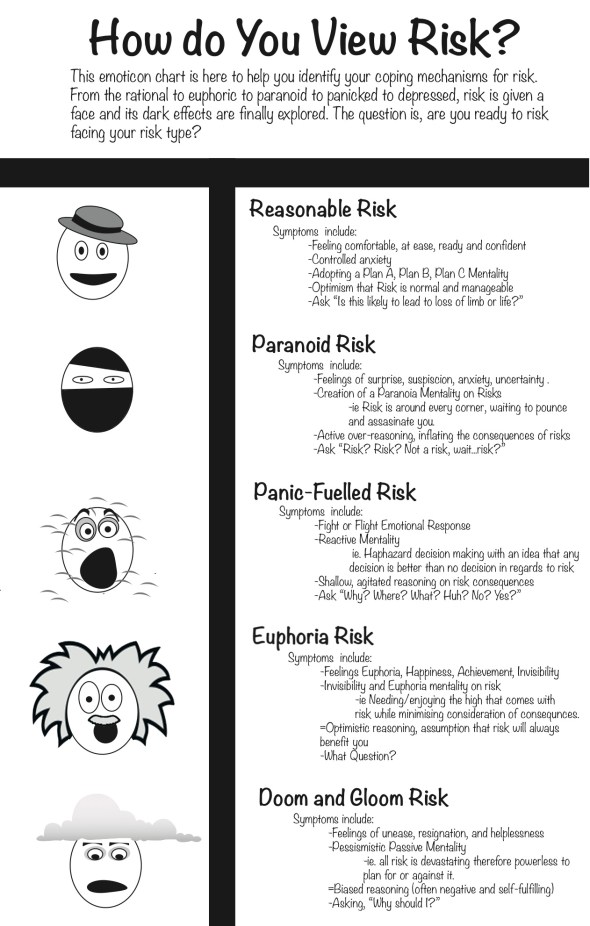
Consider how we label emotions, giving them specific and meaningful labels, such as fear, happiness, sadness, joy etc. While with risk, we usually define as being minimal, calculated, big, huge etc. Same thing in different size packages! Maybe we need to create better labels for the different types of risk we take. Maybe when we are confronted with a ‘risky’ opportunity, we need to decide where on our risk meter, our options are.
In the spirit of helpfulness, with the assistance of my friend Kelsey, I’ve come up with this basic infographic, to illustrate the ways we personify and view risk. So please check it out, I promise it’s only a little bit risky. Maybe you have something to add?
 Paper Bag Thinking