The Really Offensive “F” Word: And we know you know it!
2November 3, 2012 by Susie Ting
Last week I discussed the fear of failure as judged by others, pointing out how our fear of failure is linked to our social identity. This week I tackle the subtle, pervasive and insidious demon we all suffer from—our own internal voice predicting failure.
Fear of failure appears natural, even normal, and is epidemic as a result of our current way of thinking. From the moment we wake to the time when our head hits the pillow at night, we wage a constant battle against the inner critic. The voice that says ‘it’s too risky’ or that our ideas will probably not succeed anyway or that trying is for dreamers and losers, and that rejection will hurt. If the fear of failure is ‘normal,’ being controlled by this fear is not. It is a choice.
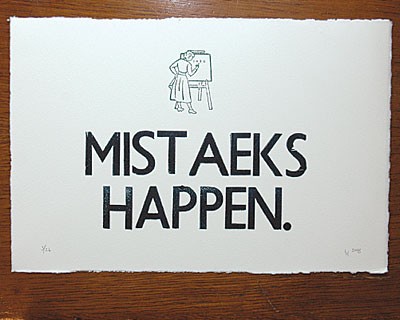
How did we get so fearful? Did we somehow decide one day that one failure on our end would cause the universe to cease and humanity to end? Nope, the truth is we became infected with ‘perfectionitis.’ The fiction or obsessive ideal that what we present to the world must be the most polished, complete and whole creation we have ever developed. No scratches, no flaws, no inconsistencies should mar the surface of our idea, item or product. Perfectionitis has a residual effect too, one where we disparage or belittle our achievements, telling ourselves how ordinary our thoughts, ideas and creativity are in the grand scheme of things.
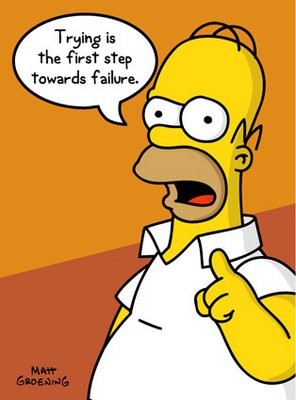
But perfectionitis is not the only thing that has been holding us back. Fear of discovering ourselves to be ‘less’ than we would like haunts our steps in the same way as Voldemort haunts Harry Potter, becoming the he-who-shall-not-be-named of our greatest fears. We don’t want to fail. A perfectly acceptable goal you might say, but since when does not wanting to fail mean we avoid trying something new? Think back to your childhood. How many times did you fail to ride a bike before you proudly peddled that darned two-wheel contraption down the street? The answer is usually lost in the mists of time. So yes, we ‘fail’ before we succeed more often than not. When did our thinking turn into a deep-seated belief that failing is the worst thing that can ever happen?
Some light can be shed when we look at our unimaginative use of the word “failure.” For such an eloquent and subtle language, English has given us one word that we use to describe everything from world-ending catastrophes right down to not being able to properly spell a particular word, or get the soufflé to rise. So, it is no wonder we struggle with a fear of failure, for the word itself pushes us to oscillate between two extremes, anticipating cataclysmic painful consequences when we do not succeed to master the cha-cha. Yet not all blame can be placed on language or on the judgement of others, we do contribute to the problem ourselves.
We craft narratives in our heads, seeing ourselves as tragic heroes, fighting the good fight but sadly destined to fail while accepting ‘lives of quiet desperation’. And we need to stop doing that. We can all be successful, courageous risk takers; visionaries and, at the same time, accept that we are not so successful in some respect or other. We must embrace the truth that we are complex human beings, and not always either the fabled hero or the town dullard. Maybe you are awesome at Word With Friends, not so great at cooking French cuisine and when it comes to your ideas, some are winners, some are duds and maybe some are just out of time and place. Maybe my talents and shortcomings are different from yours. So we need to forgive ourselves for feeling anxious when trying and accept that our expectations are hopes, goals and aspirations and not unyielding laws.
Yes, you know that you know, so how do we stop our fear of failure from haunting our every step?
 Paper Bag Thinking
We stop it by having hope. The best defense against fear is hope.
Thanks for commenting. Hope IS important, although I do think it depends on how we see hope. Some people see it passively as they simply shrug and ‘hope’ that ‘their world will get better all by itself’ and others see ‘hope’ as a faith, belief or optimism that if they keep on making an effort, believing that they can change things, then their world will eventually get better